In a March 2026 Reddit thread that quickly crossed 8,000 upvotes, a senior engineer at a Series-B startup posted screenshots of a take-home interview he had just rejected. The candidate, a recent CS graduate with a 3.9 GPA from a respected program, had submitted code that ran perfectly on the happy path and silently corrupted data on every edge case. When asked to walk through the logic on a follow-up call, the candidate could not explain why one of his own functions used recursion. The line that broke the thread was his honest answer: “I just told Claude what we needed and it wrote this. I usually only read the code if it doesn't work.”
This is the vibe coding crisis, and by 2026 it has migrated from developer Twitter into HR pipelines, hiring debriefs, and increasingly into the offices of CS department chairs trying to figure out what just happened to their graduates. The term was coined by Andrej Karpathy in February 2025 to describe a positive new mode of working: describe your intent, accept what the model produces, ship. Within a year the same phrase became the field's shorthand for a generation of programmers who can prompt fluently but cannot reason about what their code actually does.
For programming educators, this is not a hypothetical problem about the future of work. It is a present-tense pedagogical emergency about the students you are graduating right now. This article looks at what the research and field reports actually show about AI-induced skill atrophy, why CS1 through senior capstone is uniquely vulnerable, and how a small but growing group of educators is restructuring courses to ensure students graduate able to code — not just able to prompt.
What Vibe Coding Actually Means (And Why Karpathy Said It Should Be Fun)
Karpathy's original framing was specific. Vibe coding meant accepting that programming for personal projects could now feel like creative play: you tell the model what you want, it produces code, you adjust the prompt rather than the code, and you ship something working. He explicitly noted he was no longer reading code line-by-line for his own side projects. The framing was about enjoyment, productivity, and the legitimate observation that for low-stakes throwaway code, careful manual review is overkill.
The term then escaped into the wider field, where it landed in two very different contexts:
- Senior engineers using it deliberately: Treating AI-generated code as a draft, reading and refactoring it before commit, using AI to skip boilerplate but applying decades of pattern-recognition to evaluate output. This is what Karpathy was describing, and it works.
- Junior engineers and students adopting it as their default mode: Treating AI-generated code as a finished artifact, accepting it without reading, debugging only when tests fail, escalating to a senior or instructor only when AI cannot fix its own output. This is what Karpathy was not describing, and it does not work.
The pedagogical problem is the second group, and they make up the majority of students entering CS programs in 2026. Karpathy himself walked back his framing later in 2025, noting that vibe coding makes sense for experts on personal projects and is corrosive for everyone else.
The Skill Atrophy Pattern in Real Numbers
The evidence is now substantial, and it points in one direction. A December 2025 analysis published by CodeRabbit, examining pull requests across hundreds of open-source repositories, found that code coauthored by generative AI contained roughly 1.7× more “major” issues than human-written code. Logic errors (incorrect dependencies, flawed control flow) and security vulnerabilities were both significantly elevated, with security defects appearing at 2.74× the rate of human-only code.
A TechSpot report in late 2025 surveyed working developers about cognitive effects of forced vibe-coding workflows. The common reported pattern: rising debugging time, declining ability to mentally simulate code, and a deteriorating intuition for what production-quality code looks like. One developer described his experience after six months of vibe-first work as “losing the muscle memory” for problem-solving entirely.
The clearest illustration came from a developer who ran a 30-day experiment in early 2026: no AI assistance for one month, then reflect on the difference. The dev.to writeup, I Coded Without AI for 30 Days: The Results Were Embarrassing, became one of the most-shared developer essays of the year. The core finding: a working senior engineer with eight years of experience could no longer write a simple binary tree traversal from memory. The skill had been outsourced and then quietly eroded.
If a working senior engineer's debugging muscle deteriorates within months of AI dependence, imagine the trajectory for a CS1 student who has never had that muscle in the first place — whose entire experience of programming has been mediated through an LLM that produces a working solution within ten seconds of seeing the problem statement.
Why Programming Education Is Uniquely Vulnerable
Other fields are coping with AI in education imperfectly, but most still have intact assessment frameworks. A student in literature can still be asked to discuss a passage in seminar. A student in chemistry can still be asked to perform a lab procedure. A student in mathematics can still be asked to derive a proof at a blackboard. Programming education has none of these intact assessment modes. Almost every programming assignment is a take-home, evaluated by whether the code passes tests — and a 2026 AI passes those tests trivially.
This creates three vulnerabilities that programming-specific:
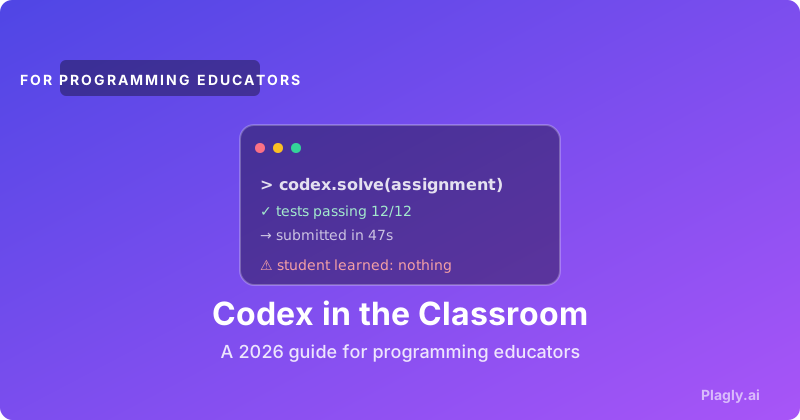
- The assignment-test loop is fully automatable. Codex, Claude Code, and Cursor read the assignment, write the code, run the test suite, iterate on failures, and submit a working solution. The complete cycle a student is supposed to perform — understand requirements, design a solution, implement it, debug it — can be performed by the AI faster than the student can read the spec.
- Live evaluation is logistically expensive. A 200-student CS1 class cannot realistically perform a five-minute oral defense on every assignment without burning twenty hours of TA time per assignment cycle. The economic model of large CS courses assumes asynchronous take-home grading.
- The cheating is invisible to the student. A student who copies an essay knows they cheated. A student who prompts an AI to solve an assignment may not register it as cheating — the social norm has shifted faster than the policy has, and the act feels indistinguishable from looking something up. By the time they reach senior year and need to think for themselves, they have spent four years building no relevant skill.
The result is a graduation pipeline producing students with credentials that no longer correlate with skill. Hiring managers in 2026 are increasingly bypassing the resume and the GPA in favor of live technical evaluation, exactly because the credentialing system has decoupled from the underlying capability.
What “Learning Nothing” Looks Like in CS Office Hours
If you teach programming, you have probably seen this pattern, even if you have not yet named it. We have compiled the most common diagnostic signals from instructors across CS1, data structures, and senior capstone courses in late 2025 and early 2026.
- The student cannot find their own bug. Submission ran perfectly. New unit test fails. Student opens the file, looks at the code as if seeing it for the first time, scrolls up and down without a hypothesis, eventually says “I'll just ask Claude what's wrong.” The first reaction to a failing test is to escalate to AI rather than form a hypothesis.
- The student cannot answer “why”. Asked “why did you use a hash map here instead of an array,” the answer is “that's what the AI suggested.” The choice was made; the reasoning behind it was never internalized. There is no cognitive model under the code.
- The student cannot make a small variant. “Modify this to also handle negative numbers” should be a thirty-second edit. For the AI-dependent student, it becomes a five-minute prompting session because they need to feed the constraint back to the model rather than thinking through where in the existing code the modification should go.
- The student is fluent in tools, illiterate in problems. They can configure Vercel, build a React component, set up a Postgres database, deploy with Docker. They can use the entire modern toolchain. Ask them to implement quicksort. Silence.
- The capstone reveal. Senior capstone, the moment when accumulated skill should pay off, is increasingly a moment when accumulated absence of skill is revealed. Teams that vibe-coded their way through CS1 through junior year arrive at capstone unable to design a system, unable to break down a feature, unable to handle the parts of programming that AI does worst.
The Pedagogical Fix: Treat AI Fluency as a Real Skill (And Make It Earnable)
The educators who are managing this transition well are not the ones with the strictest no-AI policies. They are the ones who have rebuilt courses around a clear distinction: AI is a tool that students should learn to use well, AND students must independently demonstrate the cognitive skills the AI exercises. The two requirements are not in tension — they are complementary, and the courses that get this right produce graduates who out-perform both vibe-coders and AI-banned cohorts.
The specific design patterns we see working in 2026 programming courses:
- 1. The two-track assignment. Every assignment has a “solo” portion (no AI allowed, often a small in-class component) and a “tools” portion (AI permitted but documented). The solo portion catches what the student can actually do. The tools portion teaches them to do more.
- 2. AI fluency as a graded competency. Students submit AI prompts they used, the responses they got, and an analysis of where the AI was wrong or inefficient. Reading AI output critically is treated as a course objective, not a workaround.
- 3. Debugging-only assessments. Students are given working AI-generated code with subtle bugs (off-by-one, wrong base case, missing null check, security vulnerability) and graded on their ability to find and fix them. This trains the skill AI most poorly performs and that employers most value.
- 4. Process-visible grading. Required commit history, mandatory comments documenting design decisions, recorded walkthroughs. The artifact alone is no longer the whole grade.
- 5. Live technical conversations. A short, structured oral component on every significant assignment. Five minutes per student, focused on one or two diagnostic questions. The friction is real; the signal is excellent.
- 6. Authenticity verification at the system level. Tools like Plagly.ai scan submissions for AI-generation patterns, cohort-level stylistic uniformity, and the absence of the iterative authorship traces real student work usually exhibits. This is not the grade; it is a flag that surfaces the submissions worth the office-hours conversation.
The Tool Layer That Makes This Practical
The biggest objection to the model above is logistical. Real classes have hundreds of students; real instructors do not have time to read every submission line-by-line, perform an oral defense on every assignment, or notice cohort-level patterns by eye. The tooling has to do the surface scan so the human can apply judgment to the cases that matter.
What this looks like in practice for a 200-student CS1 section:
- Submissions auto-scan: Every uploaded file goes through an AI-detection pass that returns a confidence score and per-block flags. Plagly.ai performs this analysis at 99% accuracy across GPT-5.5, Claude 4.6, Gemini 3.1, and other major models, including the specific code variants those models prefer.
- Cohort-level dashboard: The instructor sees a clustering of stylistic patterns across the section. When eight submissions share idiomatic phrasing, identical comment density, and the same defensive-edge-case pattern, the cluster surfaces for review.
- Authorship traces: Plagly.ai's Agentic Council — seven domain expert models analyzing the submission for writing quality, structure, AI detection, originality, and consistency — produces a referenced report. The report does not assert academic dishonesty; it documents the patterns the instructor can investigate.
- Targeted office-hours conversations: Students whose submissions surface get the five-minute oral check. Most are quickly cleared; the small number that are not become the cases the instructor handles thoughtfully and on the record.
The point is not to catch every cheater. The point is to keep the learning loop intact for the students who want to learn. A class without verification is a class where the students gaming the system set the curve and the students working honestly become the suckers. A class with verification is a class where the social norm holds — the assignments still teach, the grades still mean something, and the graduates can still code.
The 18-Month Outlook for Programming Education
Most working programming educators we talk to in 2026 share a sense that the current setup is unstable. The take-home assignment evaluated by test-passing is structurally incompatible with the existence of agentic coding tools. Something has to give. Three plausible directions, in roughly increasing order of likelihood:
- Full AI bans: Some institutions will try, and most will fail. The bans are unenforceable, the policies become inconsistent, and the students who follow the rules graduate less skilled than the students who do not. This is the worst-of-both-worlds outcome and it has already discredited itself at several universities that tried it in 2023-2024.
- Capability shift downward in the curriculum: CS1 starts later, with more emphasis on conceptual foundations. CS2 covers what CS1 used to cover. Advanced courses become more theoretical because the implementation portion is no longer where the learning happens. This is happening, slowly.
- Assessment shift toward live demonstration: Take-home assignments become formative. Summative grades are determined by live coding under supervision, oral defenses, and process-visible work. This is the direction the strongest CS programs are already moving, and it is the direction we believe most programs will eventually settle into.
None of these outcomes solves the question of what to do this semester, with the students you have. For that, the practical move is a hybrid: keep your current assignments, add a verification layer that catches the worst cases, layer in one or two in-person assessment components per course, and start the slower work of redesigning the curriculum for a world where agentic AI is the baseline. The verification tooling buys you time to do the curriculum redesign without losing this cohort to vibe coding in the meantime.
Restore the Learning Loop in Your Programming Courses
Plagly.ai gives programming educators the verification layer they need to teach in 2026: AI-generation detection for code submissions across every major language, cohort-level pattern analysis, sentence-level (and line-level) evidence reporting, and the Agentic Council multi-expert review for any submission that needs deeper documentation. Educator accounts come with bulk-upload, classroom dashboards, and FERPA-compliant data handling.
Try Plagly.ai Free for EducatorsFrequently Asked Questions
Is vibe coding always bad, or is it sometimes legitimate?
It is legitimate for experienced developers working on low-stakes personal projects where the cost of bugs is low and the developer has the underlying skill to evaluate output when it matters. It is corrosive for students who are still building the underlying skill, because it short-circuits the cognitive work that programming education is supposed to develop. The distinction is roughly the same as the distinction between a chef ordering takeout (fine) and a culinary student ordering takeout for their final exam (not fine). Both involve receiving food they did not cook. Only one undermines the learning project.
Can students claim they wrote AI-detected code themselves?
They can, and sometimes they are correct. False positives in code detection are most common when students write very textbook-style code that happens to match patterns AI typically produces. The defensible workflow does not treat a detection score as a verdict — it treats it as a prompt for a five-minute conversation. A student who wrote their own code can explain it, modify it on the spot, and trace its execution. A student who prompted it almost never can. The conversation, not the score, is what resolves the question. Plagly.ai's reports are designed to support that conversation, not to replace it.
How does code AI-detection differ from prose AI-detection?
Code detection uses similar statistical foundations — perplexity, burstiness, stylistic fingerprinting — but applies them to different surface features. In code, the most informative signals are structural rather than lexical: variable naming patterns, comment density and style, library usage idioms, error-handling boilerplate, and the choice of idiomatic constructs. Multi-model ensemble detectors achieve 90-95% accuracy on isolated code submissions in 2026, climbing well above 95% when cohort-level pattern analysis is combined with file-level scoring.
What about students who genuinely use AI as a tutor without copying its output?
This is the population that the verification layer is explicitly designed not to penalize. A student who used AI to understand a concept, then wrote their own solution, produces code that does not match AI generation patterns at the line level. Detection signals catch the artifact, not the research process. If your course policy permits AI-as-tutor — and we think it should — the workflow continues to work. You are checking the submission, not the student's learning method.
Does this work for project-based courses and capstones?
Yes, with adaptation. For multi-week, multi-file project work, the most useful signals shift toward process visibility: commit history analysis (did the code appear in one large commit, or did it evolve over time?), authorship consistency across files (does the codebase read like one person wrote it, or like different patches were stitched together?), and design-decision documentation (can the student explain why specific architectural choices were made?). Capstone-style projects benefit most from a structured oral defense plus a written design rationale, with AI-detection as a tertiary signal rather than the primary one.