AI Detection & Academic Integrity Blog
Guides, research, and insights on AI detection, plagiarism prevention, and academic integrity.
How to Detect DeepSeek R1 AI Writing: Reasoning Traces, Benchmark Analysis & Telltale Signs
DeepSeek R1 and reasoning models present unique challenges for AI detectors. Discover the architectural tells, chain-of-thought residue, and empirical benchmark data behind identifying R1 writing.

New AI Models 2026/2027: GPT Astra, Fable 5.1, Gemini 3.8 & DeepSeek — Full Benchmark & Detection Guide
As the 2026/2027 academic and professional cycle begins, frontier models like GPT Astra, Fable 5.1, Gemini 3.8, and DeepSeek-R1 are redefining synthetic writing. Here is an exhaustive benchmark review of model capabilities, detection rates, and which detection tools actually work.
How to Tell If a Social Media Post Was Written by AI
Stop counting emoji and em dashes — neither works. The real giveaway in an AI-written caption is rhythm: unnaturally even sentences, everything in threes, and a strange reluctance to name anything specific. Here's what to look for on each platform, plus the tells you should ignore.
How to Check If an Image Is AI-Generated (Without Guessing)
The visual tells everyone learned — six fingers, garbled text, plastic skin — were artifacts of one model generation, and they got fixed. Here's what actually works now: reading what the file says about itself, and why asking for the original file matters more than any detector.
How to Tell If Text Was Written by Claude (Sonnet 5 & Opus 5)
Most 'spot the AI' advice treats every model as one thing. Anthropic Claude (including Sonnet 5 and Opus 5) has its own habits: balanced rhetorical posture, subtle symmetry, and structured pacing. Here's what actually identifies it.
Can You Actually Make AI Text Undetectable?
Yes, you can usually lower a score. No, that is not the same as undetectable — and the gap between those is where the trouble lives. How humanizers actually work, the specific damage they do to your text, and honest advice for the three very different people asking this question.
Is Using AI to Edit or Paraphrase Your Essay Cheating? (2026 Rules)
Spell-check is fine; ChatGPT writing your essay isn't. But what about rephrasing, restructuring, or AI editing? Here's the 2026 spectrum from acceptable to misconduct — and how to stay safe.
Can You Lose a Scholarship for Using AI? Real Cases & How to Protect Yourself (2026)
Losing a scholarship over AI is no longer hypothetical — students have been expelled and even lost visas. Here are the real cases, what's at stake, and how to protect your funding (whether you used AI or not).
Best AI Humanizers in 2026: An Honest, Integrity-First Comparison
Hundreds of AI humanizers promise to make ChatGPT text 'sound human' — and the biggest get millions of visits a month. We tested the leaders honestly: which preserve your meaning, which quietly wreck it, and how to choose without risking your reputation.
Can an AI Avatar Replace a University Professor? Inside the AI Instructors of 2026
Georgia Tech has DAI-vid. Boise State runs an entire course taught by an AI avatar. Alpha School replaces teachers with software. Here's the honest evidence on what AI instructors do well, where they systematically fail, and the division of labor that's actually emerging in higher ed.
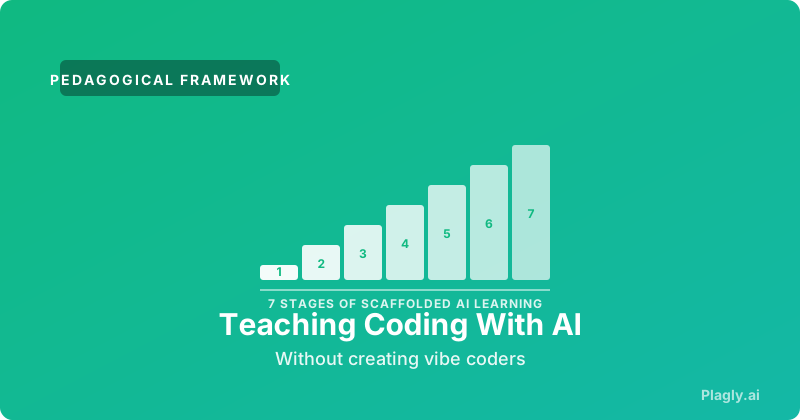
Teaching Coding With AI Without Creating Vibe Coders: A Pedagogical Framework for 2026
Banning AI failed. Allowing free AI use failed. The third way — using AI as carefully scaffolded teaching assistance grounded in productive struggle and the zone of proximal development — is what works. Here's the 7-stage framework for AI-assisted coding instruction every programming educator needs.
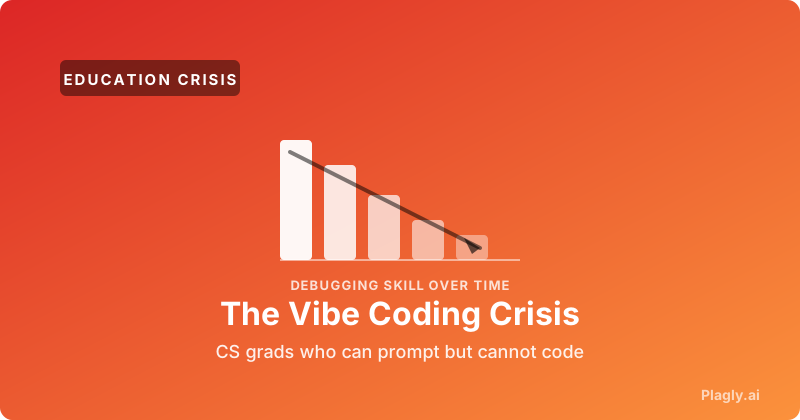
The Vibe Coding Crisis: Why CS Graduates Can't Code Without AI Anymore
Andrej Karpathy coined the term in February 2025. A year later, vibe coding is producing CS graduates who pass interviews on the screen and fail them on the whiteboard. Here's the data on AI skill atrophy — and what programming educators are doing about it.
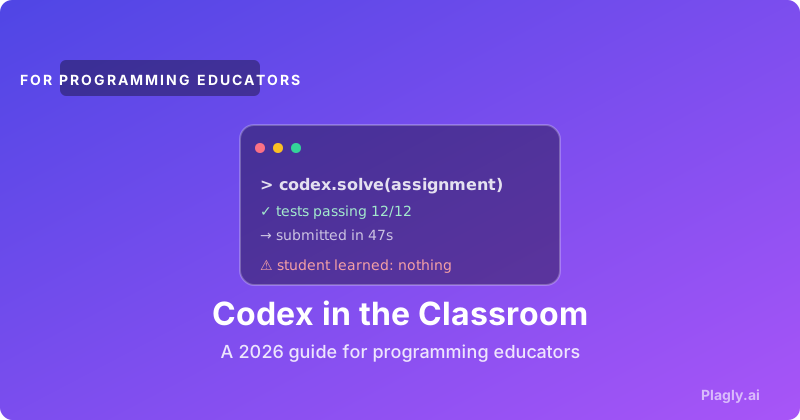
Codex in the Classroom: A 2026 Guide for Programming Educators
Codex, Copilot, and Claude Code can ace almost every undergraduate programming assignment. Here's how the educators who refuse to surrender the classroom are redesigning courses for the agentic-AI era — with real research, real strategies, and real numbers.
GPT-5.5 vs Claude 4.6 vs Gemini 3.1: Which 2026 AI Is Hardest to Detect?
Three frontier models, one detection benchmark. We tested raw and humanized output from GPT-5.5, Claude 4.6, and Gemini 3.1 — and the model that's hardest to detect isn't the one most people would guess.

Universities Are Cracking Down on AI Humanizers in 2026: New Policies Explained
After eighteen months of the humanizer arms race, universities are pushing back. New academic-integrity policies in 2026 explicitly classify humanizer use as misconduct — and detectors have caught up faster than vendors will admit.

Turnitin AI Detection in 2026: What Teachers See (and How to Pre-Check Your Work)
Turnitin's AI detection is now the default at most universities — but few students know what it actually flags or what their professors see. Here's the full breakdown plus a smart pre-submission workflow.
AI False Positives: Why Your Original Essay Got Flagged (and How to Prove It)
You wrote every word yourself, but the AI detector says 87% machine-generated. False positives are a real problem in 2026 — here's why they happen, who they target, and what evidence wins your appeal.
Is GPT-5.5 Detectable? Testing AI Detection on OpenAI's Newest Model (2026)
GPT-5.5 was supposed to make AI detection obsolete. We ran 500 fresh GPT-5.5 samples through every major detector to find out which tools still catch it — and which ones quietly broke.
Academic Integrity in the Age of AI: A New Frontier
The fundamental principles of academic integrity are being challenged by AI. We look at how educational institutions are adapting and what it means for the future of learning.
GPTZero vs Plagly.ai: Choosing the Best AI Detector for 2026
Selecting the right AI detection tool is critical. We perform a head-to-head test between two industry leaders to help you decide which platform fits your needs.
How Does AI Detection Work? The Technology Behind the Scenes
AI detection is part linguistics and part advanced statistics. We pull back the curtain on the technology that allows software to identify machine-generated patterns.

Is Using ChatGPT for Homework Cheating? The Ethics of AI in School
The line between a helpful tool and academic dishonesty is often blurry. We analyze the current consensus among educators and the ethical framework for AI assisted learning.
A Student Guide to Avoiding Plagiarism: Writing with Integrity
Plagiarism is often a result of poor planning rather than bad intent. Our student guide provides actionable steps to ensure every piece of work you submit is entirely your own.
Best AI Detectors in 2026: Honest Comparison & Accuracy Tests
With dozens of AI detectors on the market, which ones actually deliver reliable results? We put the leading tools through rigorous testing with real-world content samples to find out.
AI Writing vs Human Writing: Key Differences You Should Know
AI and human writers produce text differently at every level, from word choice to paragraph structure. Understanding these differences is key to evaluating content authenticity in the age of generative AI.
How to Check Your Paper for Plagiarism (Free Tools & Tips)
Submitting a paper without checking for plagiarism is a risk no student should take. Here is how to use free plagiarism checkers effectively and ensure your work meets academic integrity standards.
Can Teachers Tell If You Used ChatGPT? Yes — Here's How (2026)
Students wonder if their professors can spot AI-assisted work. We break down what the latest research reveals about teacher detection capabilities and the tools institutions are deploying.
How to Check if Text Is AI-Written — 5 Free Methods (2026)
AI-generated text is everywhere, from student essays to marketing copy. Learn the most reliable methods to identify whether content was written by a human or an AI model like ChatGPT, Gemini, or Claude.