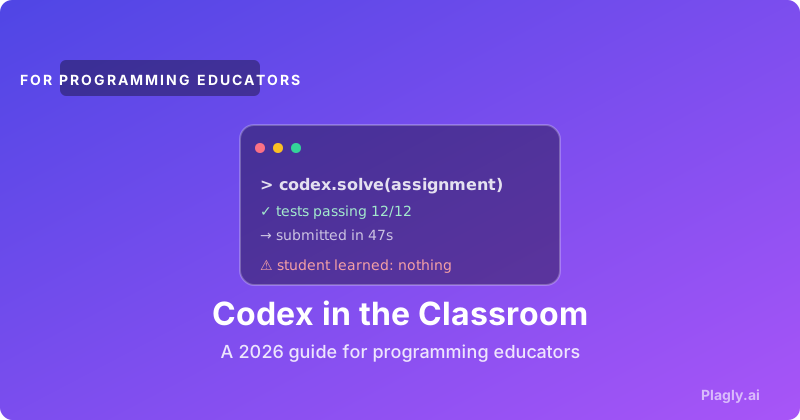
If you teach programming in 2026, you have two options that do not work and one that does. The two that do not work are familiar: ban AI from your course (unenforceable, drives use underground, leaves graduates unprepared for industry) or let students use AI freely (produces graduates who can prompt but cannot reason). The option that does work is harder. It requires you to redesign how AI shows up in the learning loop — not as a problem-solver, not as a forbidden tool, but as a carefully scaffolded teaching assistant that hands students the cognitive work the AI was about to do for them.
This is the pedagogical framework you need. Not a list of AI policies. Not a detection arms race. An actual instructional model, grounded in three decades of learning-science research on scaffolding and the zone of proximal development, retooled for the era of agentic coding tools that can ace any homework prompt.
This guide is for programming educators who want to build the curriculum that produces real programmers in 2026. We will walk through the pedagogical foundations, the seven-stage framework for AI-assisted coding instruction, the classroom patterns we have seen work across CS1 through senior capstone, and the tooling layer — including Plagly.ai — that makes the framework practical at scale.
Why Both Extremes Failed in 2024-2025
The two-year experiment is over and the verdict is in. Programs that banned AI outright (a small wave of CS departments in 2024) saw enforcement collapse within a semester, graduates who had skirted the policy quietly, and a widening gap between their students and the workforce. Programs that took the opposite approach — no policy, students use whatever they want — produced cohorts that hit the workforce unable to debug their own code. Hiring managers responded by adding live-coding interviews and skill audits that the credentialed graduates failed.
Both failure modes share a root cause. They treated AI as a yes/no question instead of a pedagogical variable. The right question is not should students use AI. It is at what point in the learning loop should AI intervene, and in what mode. That is the question this framework answers.
The Pedagogical Foundation: Productive Struggle and Scaffolding
Two concepts from learning science underwrite everything that follows. The first is productive struggle: the cognitive state in which a learner has enough information to make progress but not enough to make progress effortlessly. Research consistently shows that learning happens in productive struggle. Tasks that are too easy build no skill. Tasks that are too hard build only frustration. The sweet spot in between — the zone of proximal development — is where neural pathways for problem-solving actually form.
The second concept is scaffolding: the temporary support a more capable other (traditionally a teacher, peer, or textbook) provides so the learner can operate just beyond their independent capability. The scaffold is removed gradually as the learner internalizes the underlying skill. Good scaffolding does not solve the problem; it supports the student in solving the problem themselves.
The pedagogical failure of vibe coding is now visible in this frame: an LLM that produces a finished solution destroys productive struggle by removing the cognitive work that produces learning. It is the equivalent of a tutor who solves every problem the moment the student frowns. The student stays in the chair, but no learning happens because no struggle happens.
The pedagogical opportunity is also visible. The same LLM, configured to preserve productive struggle — to ask diagnostic questions, provide partial hints, refuse to write code the student has not earned the right to see — is the most powerful scaffolding tool ever invented. It is patient. It is infinitely available. It adapts to each student. It never gets frustrated. The same model that destroys learning when configured one way enables learning when configured another way.
Recent research published on arXiv in November 2025 (Scaffolding Metacognition in Programming Education) confirmed this empirically. The study found that students stressed AI systems should “resist giving full answers too quickly,” preferring scaffolded approaches with step-by-step hints and adaptive questioning. Students were not asking for less AI assistance. They were asking for better-designed AI assistance.
The Seven-Stage Framework for AI-Assisted Coding Instruction
Here is the framework we have refined over the past eighteen months with programming instructors across CS1 through senior capstone. It separates the learning loop into seven distinct stages and prescribes what AI should and should not do at each stage. The framework is opinionated — the point is to give educators a default they can adapt, not an infinite menu of options.
Stage 1: Problem Encounter
The student reads the problem statement. AI's role here is none. The student must form their own initial understanding before any AI assistance is permitted. This is non-negotiable. Letting AI summarize or explain the prompt at this stage short-circuits comprehension. In practice this can be enforced through course conventions (“no AI for the first ten minutes”), submission rules (must include a written restatement of the problem before AI assistance), or simply through cultural expectation reinforced consistently.
Stage 2: Decomposition
The student breaks the problem into subproblems. AI's role here is diagnostic questioning. The student writes a draft decomposition and AI asks Socratic questions about it: “What changes if the input is empty?” “How does your plan handle duplicate elements?” “Where in your subproblems does the actual algorithmic work happen?” AI is forbidden from proposing its own decomposition; it can only probe the student's.
Stage 3: Approach Selection
The student commits to an algorithmic strategy (recursion vs iteration, hash map vs array, etc.). AI's role here is comparison and trade-off analysis. Once the student has proposed an approach, AI can compare it to alternatives, articulate the trade-offs, and ask whether the student's choice fits the constraints. AI does not select. AI helps the student understand what their selection means.
Stage 4: Implementation
The student writes code. AI's role here is the most nuanced. The default is syntax and idiom support only: AI can answer “what is the Python syntax for a list comprehension that filters and transforms,” but not “write the list comprehension I need for this problem.” AI can correct a syntax error but not redesign the function. For advanced students or capstone work, this can relax: AI as pair programmer, with the student leading. For CS1, it should not.
Stage 5: Testing and Debugging
The student runs tests and encounters failures. AI's role here is guided hypothesis generation. When a test fails, AI does not say “the bug is on line 12.” It asks: “Where in the code do you think the bug might be? What does your function return when the input is empty? Walk me through what happens with this test case step by step.” This is where the most learning happens, and the most temptation to short-circuit. AI configured well here trains debugging intuition that lasts a career. AI configured badly destroys it.
Stage 6: Refactoring and Reflection
The student has working code. AI's role here is critique and alternative-presentation. AI can now show how a senior engineer might write the same code, explain why their version is better or different, and ask the student to evaluate the comparison. This is the stage where AI can be at its most generative — the underlying learning has already happened, and the value-add is exposure to higher-quality patterns.
Stage 7: Generalization
The student must transfer the skill to a slightly different problem. AI's role here returns to none. A small variant of the original problem is presented and the student solves it without AI assistance. This is the assessment moment. If the student internalized the underlying skill, the variant is straightforward. If they did not, the variant exposes the gap.
Translating the Framework Into Classroom Patterns
The framework is the principle. The classroom patterns below are the practice. Each pattern operationalizes one or more stages of the framework into a concrete assignment or activity. Educators report these consistently as the patterns that work.
- The two-track assignment. Every significant assignment has a solo portion (Stage 7 generalization, no AI) and a tools portion (Stages 1-6, scaffolded AI). The solo portion is shorter but graded equally. This catches what the student can actually do while letting them learn from AI on the larger work.
- The decomposition-first submission. Before any code is written, the student submits a written decomposition of the problem. AI is forbidden at this stage by course convention. Graded for clarity of thinking, not eventual correctness. Often worth 20-30% of the assignment.
- The AI-asks-questions chatbot. Provide students with a course-specific AI tutor (a system prompt that enforces the framework's Stage 2-5 behaviors) that they are required to use for help, and that refuses to provide direct code. Several universities have built these in-house; off-the-shelf options like Code.org's AI Tutor embed Socratic principles directly.
- The debugging-only assessment. Give students working AI-generated code with subtle bugs and grade their ability to find and fix them. This trains Stage 5 directly and rewards the skill AI itself performs worst at.
- The prompt-and-evaluate exercise. Students prompt AI to solve a problem, evaluate the response for correctness and efficiency, identify any bugs or stylistic issues, and submit both the prompt and a corrected version. Treats AI fluency as a graded skill rather than a workaround.
- The oral defense. Five minutes per student on significant assignments. Two diagnostic questions: walk me through this function, and modify it to handle a small variant. Catches everything the framework was designed to teach and almost nothing else.
- The cohort verification scan. Every submission runs through a verification layer that surfaces submissions worth deeper inspection. The point is not to catch every cheater. It is to keep the social norm of doing the work intact so the framework continues to function.
The Tooling Layer: What Makes This Practical at Scale
A 200-student CS1 cannot manually verify every assignment, manually scaffold every student's AI interactions, or manually conduct oral defenses on every submission. The framework is realistic only if the tooling layer takes the volume work off the instructor's plate, leaving the human in the loop for the cases where human judgment is uniquely valuable. This is the practical role of Plagly.ai in a course built around the framework.
- Code submission verification. Every uploaded file passes through an AI-generation scan that returns a confidence score and per-line flags. Plagly.ai achieves 99% accuracy across GPT-5.5, Claude 4.6, Gemini 3.1, and the agentic coding tools that combine them. Submissions with low AI scores need no further inspection. High-score submissions surface for the oral defense.
- Cohort-level pattern analysis. When eight students in a section produce solutions with the same idiomatic variable naming, the same comment density, the same defensive boilerplate, the cluster surfaces automatically. This catches the failures that single-submission analysis cannot.
- Process-trace verification. For larger projects, Plagly.ai's Agentic Council — seven domain expert models analyzing the submission across writing quality, structure, AI detection, originality, and consistency — produces a referenced report that documents whether the submission shows the iterative authorship traces real student work usually exhibits.
- Humanize-in-reverse for teaching. The Humanize feature shows what AI-typical code looks like. Used in the classroom, it becomes a teaching tool: show students a function written in AI-typical style next to the same function in idiomatic student style, and have them list the visible differences. This trains the recognition skill the framework's Stage 2 exercises depend on.
- Multi-language coverage. The signals work across Python, JavaScript, Java, TypeScript, C++, Rust, Go, and other widely-taught languages. Curriculum design does not have to bend around tool limitations.
What the Framework Looks Like by Course Level
The framework is consistent across course levels, but the calibration changes. The further along a student is, the more autonomy they earn at each stage. Three reference points:
CS1 (Introduction to Programming)
Strict framework enforcement. Stages 1, 4, and 7 have minimal AI access. Stages 2-3 use AI only in question-asking mode. Stage 5 debugging is heavily scaffolded. The instructor's goal at CS1 is to build cognitive infrastructure: the ability to read code, trace execution, form hypotheses about failures. Letting AI do any of this work at CS1 produces students who never develop it. Pair this with mandatory in-class problem-solving and an oral defense on every significant assignment.
Data Structures and Algorithms
Moderate framework enforcement. Stages 4-6 can relax slightly. AI can now be used as a pair programmer for implementation, but only after the student has independently committed to an approach (Stage 3). Debugging remains heavily scaffolded. Stage 7 generalization tasks become more abstract: prove your algorithm runs in O(n log n), modify your implementation to handle an additional constraint that requires a substantive rethink. This is where strong students start to use AI productively and weak students get exposed by the generalization tasks.
Senior Capstone and Software Engineering
Loose framework enforcement, heavy process visibility. By senior year, students should be operating closer to the workforce model: AI as collaborator, student as lead. The verification layer shifts from per-submission AI detection to process visibility: commit history, design decision documentation, recorded code review sessions. The oral defense becomes a design review — can the student justify the architectural choices, explain the trade-offs, and modify the design in response to a new constraint? This is where the framework's investment in CS1 pays off, or fails to.
What to Stop Doing in 2026
Five practices that survived from the pre-AI curriculum and now need to go. Each one actively undermines the framework when retained.
- Stop weighting take-home assignments at 70%+ of the grade. The assessment-test loop is fully automatable. A grade composition that depends on take-home performance no longer measures what it claims to measure. Shift weight toward in-class problem-solving, oral defenses, and supervised project milestones.
- Stop using auto-grader output as the sole assignment grade. The auto-grader does not know whether the student wrote the code. Combine the auto-grader score with the verification layer, and meaningful scores require oral defense.
- Stop assigning toy problems with widely-published solutions. If the problem appears on LeetCode, GeeksforGeeks, or any textbook published before 2024, the AI has seen the solution. Course-specific problem statements, datasets, and constraints force AI to actually do work rather than recall.
- Stop treating AI as outside the curriculum. AI fluency is now part of what programmers do in industry. Assignments that explicitly involve evaluating AI output, debugging AI-generated code, or critiquing AI-suggested designs teach a skill the workplace needs.
- Stop hiding the verification layer. Tell students openly that submissions are scanned for AI generation, what the framework's stages expect, and what the consequences of misuse are. Transparency improves the social norm. Hidden enforcement breeds adversarial behavior.
Build Your AI-Era CS Curriculum on the Right Foundation
Plagly.ai gives programming educators the verification and pedagogy layer the framework requires. Code-aware AI detection across every major language and model. Cohort-level pattern dashboards. Agentic Council reports that document submission authenticity at the evidence level. Educator accounts come with bulk-upload, classroom dashboards, integration with major learning management systems, and FERPA-compliant data handling. Build the framework with the tooling that scales it.
Try Plagly.ai Free for EducatorsFrequently Asked Questions
Does this framework work for self-paced and asynchronous courses?
Yes, with two adaptations. First, the oral defense moves to a recorded video walkthrough that the student submits with each significant assignment. The video is short (two to five minutes) and answers two diagnostic questions provided with the assignment. Second, the AI scaffolding tool becomes more important because the instructor is not in the room to redirect students who slip into solver-mode. A course-specific AI tutor with Socratic constraints (or a careful system prompt on a general tool) makes this workable.
What about students who learn better by reading working code?
The framework explicitly accommodates this at Stage 6 (refactoring and reflection). After the student has produced their own working code, exposure to AI-generated alternatives or expert refactors is high-value. The constraint is sequencing: AI-as-exemplar comes after the student's own work, not before. Reading great code teaches when the reader has already attempted the problem; reading great code as a substitute for attempting the problem teaches almost nothing.
How do I handle students who already use AI heavily and resent the framework?
Make the case explicitly, ideally on day one. Show them the December 2025 CodeRabbit data on 1.7x bug rates in AI-coauthored code. Reference the dev.to 30 Days Without AI essay. Talk about live-coding interviews and what hiring managers are actually doing in 2026. The students who resist the framework are usually the students who most need it. Many of them have not yet encountered the consequences of vibe coding, and once they do (often in their first technical interview), they tend to wish they had taken the framework more seriously earlier.
Can I implement the framework gradually rather than restructure my course at once?
Yes. The minimum-viable adoption is to add three things to your existing course: a decomposition-first submission requirement on one major assignment, a short oral defense on the same assignment, and a verification layer (a tool that scans submissions and surfaces patterns) running quietly in the background. These three additions move you most of the way without requiring full curriculum redesign. Most educators we have worked with start here and expand into the full framework over two to three semesters.
What if my institution has not adopted clear AI policies yet?
Most have not, and most are looking for faculty input. Adopting the framework at the course level gives you a defensible model to bring to department-level policy conversations: here is what we are doing in CS1, here is the rationale, here are the results. Faculty who proactively model good pedagogy in this space are increasingly the ones shaping institutional policy. The framework is designed to be defended in those conversations — the citations to learning science, the references to peer-reviewed research, and the explicit grounding in productive struggle and scaffolding all serve as the rhetorical scaffolding for the policy work.